Structural Optimization Guide

Structural optimization shortens the path to one page. Select the Structural strategy on a page in your LinkMap visualization and the run walks your own link graph to find the links that would bring that page closer to the homepage and the pages that should be feeding it, then draws them onto the map as planned links.

Page Depth

Your page's depth is the number of clicks it takes to reach it from the homepage. The visualization shows that distance for every page at once as distance from the central node, which is how you spot content sitting further out than you meant to put it. The run treats four clicks or more as too deep, and that is the threshold it works to.

What The Analysis Does

The run saves a snapshot of the site first, labeled as the pre-optimization state, so the before-and-after is on the timeline. It then looks for pages four or more clicks deep and, for each, scores the shallower pages that could cut that depth with a single link, weighting how much depth the link saves against how well the two pages fit topically.

For the target page itself it picks two sets of sources: the five pages with the most PageValue that could pass authority to it, and the five most similar to it by content. It also reads the parent and sibling structure around the target to find the structural relationships it should have and does not.
LinkMap after a structural optimization run, with the new planned links to the target page drawn as dashed lines from shallower pages

What You Get Back

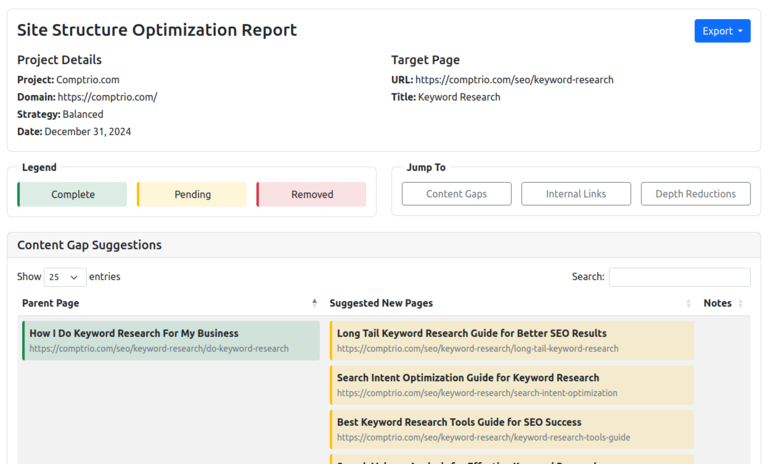
The result is drawn on the map and summarized in the same three-part report under Reports. Each link the run chose appears as a planned relationship, a dashed line from the source to the target, and where the analysis finds a content gap it adds a planned page under the right parent with its own structural links. Planned means exactly that: the map holds the plan, and building it on the site is yours to do.

Discard any planned link you disagree with using the relationship management tools. The next crawl records what was actually built, and the content relevance guide covers the topical side of the same links.

Monitoring Progress

The timeline in your LinkMap visualization holds the pre-optimization snapshot beside every crawl since, so the structure before and after is one click apart. Share the timeline with stakeholders to show the change.

Structural optimization addresses the path to the page. When the page also needs authority or topical support, balanced optimization runs all three analyses in one pass.

What Does the Math Say
About Your Site?

Finding out is free and takes minutes.

Recent Articles

Content Relevance Optimization

Content relevance is one of the four Page Optimization strategies. It works on the topic groups your pages already form and adds the links they are missing.

MCP Protocol Server Implementation Overview

What an MCP server must implement by revision: the old protocol's handshake and sessions, the stateless shape it has now, and the error codes clients read.

How to Outrank Competitors in SEO

Measure the pages ranking above you on the same things your own pages are measured on, then spend time and money only where the gap is real.

An SEO Strategy For Google SERP Features

Eighteen Google SERP features sorted by whether you can realistically win them, with what each one actually takes to earn and how to plan your SEO around it.

How to Build an SEO Report with Free Tools

Two free tools, an SEO Audit that builds a custom checklist and an SEO Report Builder for report charts, plus the nineteen checks a full SEO report runs.

Professional Keyword Research Service with Ahrefs Data

Professional keyword research on Ahrefs data, read by 25+ years of SEO experience and mapped onto your site's link structure. Delivered within 24 hours.

Popular Articles

How to Build an SEO Report with Free Tools

Two free tools, an SEO Audit that builds a custom checklist and an SEO Report Builder for report charts, plus the nineteen checks a full SEO report runs.

An SEO Strategy For Google SERP Features

Eighteen Google SERP features sorted by whether you can realistically win them, with what each one actually takes to earn and how to plan your SEO around it.

How to Outrank Competitors in SEO

Measure the pages ranking above you on the same things your own pages are measured on, then spend time and money only where the gap is real.

Content Relevance Optimization

Content relevance is one of the four Page Optimization strategies. It works on the topic groups your pages already form and adds the links they are missing.

Balanced Optimization Strategy

Balanced optimization runs the authority, content and structural analyses on one target page and draws the winning links onto your LinkMap as planned links.

Authority Focused Internal Link Optimization

Authority focus concentrates your internal links on the page you most want to rank, then draws the plan onto your LinkMap so you can see every link change.

Other Categories

Chat with your own SEO data
Connect Claude, ChatGPT, or any AI chat to your private MCP server and ask "what should I fix first?" It answers from your data - crawls, rankings, competitor research, backlinks - and can even queue new analysis for you.

Wire it into your agentic system and it can re-measure a page while your agents work on it - change, measure, repeat.

Free and paid tiers have your own private MCP server alongside the dashboard you'd expect.

No account yet? The public server below answers anything about features, pricing, or support - and will pull a real SERP correlation analysis, methodology and raw data included.
https://seolinkmap.com/mcp